Explore our flagship heavy-duty clear-span tents, modular industrial halls, and custom engineered temporary structure systems manufactured for global logistics and commercial deployment.
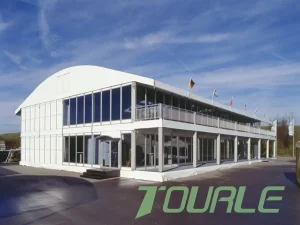
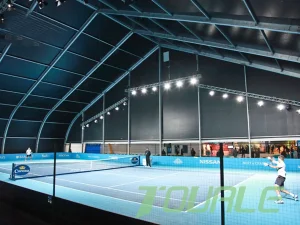
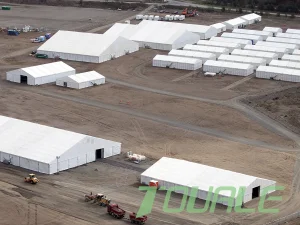
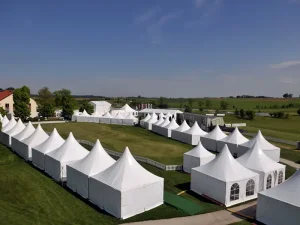
A rigorous examination of heavy-duty modular storage tent systems engineered for commercial, industrial, and agricultural applications.
In the modern global supply chain landscape, enterprise agility depends heavily on rapidly deployable, legally compliant, and environmentally resilient spatial solutions. CE Certification Storage Tent 4x6 Companies & Factories play a vital role in providing high-performance temporary and semi-permanent shelter structures. The "4x6" designation—representing either 4m x 6m modular bay units or standardized 4m span by 6m section configurations—serves as the universal structural baseline for commercial warehousing, equipment housing, and logistics overflow buffering.
Unlike light-duty consumer canopies, industrial-grade 4x6 storage tents are engineered according to stringent structural mechanics principles. The primary framing utilizes high-tensile extruded aluminum alloys (typically 6061-T6 or 6082-T6 structural aluminum) or hot-dip galvanized steel tubing (Q235/Q355 grade). These structural profiles are specifically designed to withstand significant dynamic wind pressures, localized snow accumulation, and seismic oscillations without structural failure or permanent deformation.
The operational longevity of a 4x6 storage tent depends directly on the anodization thickness of the aluminum framework (minimum 10-15 μm) and the synthetic coating matrix of the architectural PVC fabric. Standard industrial units feature double-sided PVC-coated polyester textiles with an acrylic top-coat lacquer, offering self-cleaning UV resistance, anti-fungal treatment, and a tear strength exceeding 2500 N / 5 cm along warp and weft axes.
Deconstructing structural safety mandates, EN 13782 standards, and regulatory requirements for enterprise procurement across the European Union and North America.
EN 13782 specifies safety requirements which need to be observed at design, calculation, manufacture, transport, installation, maintenance, and testing of mobile, temporary structures.
Manufacturing compliance under EN 1090-1 and EN 1090-3 ensures factory production control (FPC) for load-bearing aluminum components used in storage tent frame assemblies.
Compliance with European fire classification DIN 4102 B1, M2, and EN 13501-1 ensures self-extinguishing properties that protect high-value stored assets from fire risks.
| Certification Standard | Geographic Region | Technical Scope | Enterprise Compliance Value |
|---|---|---|---|
| EN 13782 | European Union / International | Safety & structural design of temporary fabric structures | Unlocks municipal permitting & site installation approvals. |
| EN 1090-1 / EN 1090-3 | European Union / UK (UKCA) | Execution of aluminum & steel structures (Factory Production Control) | Guarantees structural weld integrity & metal fatigue safety. |
| DIN 4102 B1 / EN 13501-1 | Global Standard | Flame retardancy of technical PVC textiles | Reduces commercial fire insurance premiums and fire hazards. |
| ISO 9001:2015 | Global Manufacturing | Quality Management Systems for manufacturing plants | Ensures batch-to-batch structural consistency and dimension precision. |
Custom-engineered structural tent configurations built to resolve critical operational bottlenecks across diverse industrial sectors.
Rapid expansion of fulfillment center capacity without the heavy capital expenditure or lengthy permit processes of traditional concrete facilities.
Rugged, field-deployable protection for expensive machinery, heavy haul vehicles, and site maintenance workshops in harsh geographic environments.
Corrosion-resistant temporary storage structures built specifically for high-salinity coastal environments and international transshipment ports.
Inside our automated production infrastructure: High-precision engineering, cost containment, and rigorous trial-assembly quality control.
The manufacturing ecosystem of CE Certification Storage Tent 4x6 Companies & Factories in China has undergone a massive technological transformation. Leading factories have evolved from simple manual fabrication shops into fully integrated Smart Factories driven by CNC precision machining, automated High-Frequency (HF) fabric welding, and computerized Quality Management Systems (QMS).
By leveraging concentrated industrial clusters for raw aluminum extrusion, steel hot-dip galvanizing, and synthetic technical textile weaving, Chinese manufacturers provide an unparalleled combination of structural precision, rapid production lead times, and total cost efficiency. This vertical integration guarantees that every frame profile, roof beam, connector bracket, and PVC fabric panel meets exact engineering tolerances prior to export packing.
Computer-controlled multi-axis milling machines process structural extrusion profiles with sub-millimeter accuracy, ensuring flawless alignment during field erection.
High-Frequency dielectric welding creates molecularly fused seams in PVC covers, producing 100% waterproof joints stronger than the surrounding base textile.
Every order undergoes full-scale trial assembly at our test grounds prior to shipment to verify member dimensions, connection fits, and fabric tension tolerances.
Analyzing key evaluation parameters, direct vs. indirect cost structures, and long-term financial metrics for corporate buyers.
When enterprise procurement teams evaluate CE Certification Storage Tent 4x6 Companies & Factories, the purchasing decision extends far beyond the initial purchase price per square meter. A holistic Total Cost of Ownership (TCO) model takes into account foundation preparation, speed of erection, energy efficiency, maintenance overhead, re-locatability, and asset residual value.
Capital Expenditure (CapEx): Modular aluminum storage tents require 40% to 60% less initial capital investment compared to permanent structural steel buildings.
Deployment Speed: A standard 4x6m or 1000m² modular warehouse tent can be fully erected and operational within 48 to 72 hours, drastically shortening project launch cycles.
Taxation & Amortization: Because temporary fabric structures are classified as movable equipment in many tax jurisdictions, they qualify for accelerated depreciation schedules rather than 30-year real estate amortization.
Tailoring structural dimensions to exact workflow demands:
Maximizing container loading efficiency:
Innovations driving the next generation of smart, sustainable, and energy-efficient modular temporary structures.
Next-generation flexible thin-film photovoltaic panels integrated directly onto PVC tent roof covers generate off-grid clean energy for remote industrial operations.
Smart structural health monitoring systems incorporate strain gauges and snow load displacement sensors, sending real-time alerts to maintenance teams during winter storms.
Development of 100% recyclable TPU (Thermoplastic Polyurethane) coated architectural membranes that eliminate phthalates while providing higher tear resistance.
End-to-end service support covering engineering stamps, customs duty optimization, and localized field installation supervision.
Our structural engineering department provides site-specific FEA calculation packages signed by qualified engineers to smooth local building code approvals across the EU, US, and Australia.
Clear documentation under international Harmonized System codes (HS 6306.22 for synthetic fiber tents / HS 7610.90 for aluminum structures) minimizes tariff delays during port clearance.
We provide comprehensive 3D installation videos, step-by-step PDF assembly manuals, and option for dispatched site engineers to guide local construction crews.
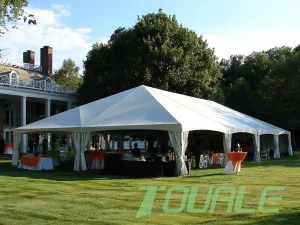
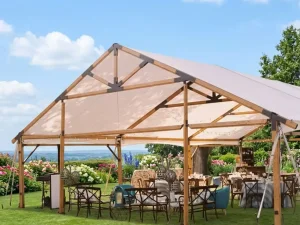
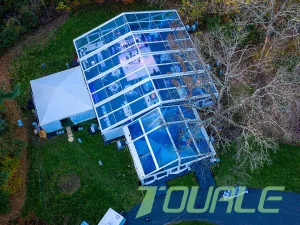
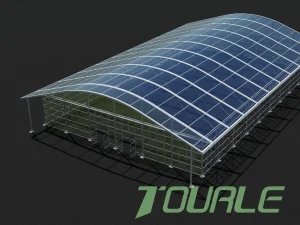
Browse our extended catalog of customizable industrial warehouses, pagoda units, sports halls, and clear-span marquee tent configurations.
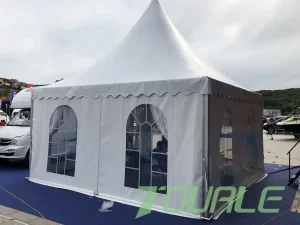
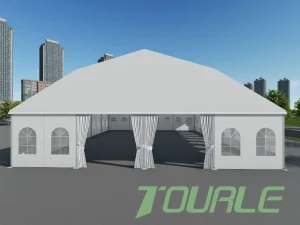
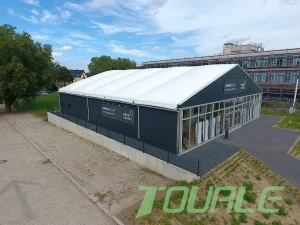
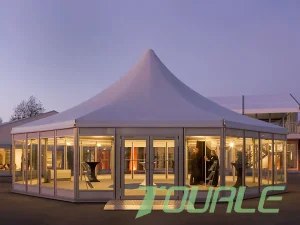
In-depth engineering answers addressing compliance, installation, maintenance, and structural durability.
Qualified CE-certified manufacturers use structural engineering software (such as ANSYS or RSTAB) to run Finite Element Analysis (FEA) based on Eurocode 1 (EN 1991) guidelines. Wind load calculations account for internal and external pressure coefficients, local ground terrain categories, and structural sway. Standard industrial storage tents are calculated to withstand minimum wind speeds of 100 km/h (0.5 kN/m²) and snow loads of 0.25 kN/m² to 0.75 kN/m², expandable with reinforced steel truss profiles.
EN 13782 is the European standard designed specifically for temporary structures (tents, marquees, and relocatable industrial halls). It allows for optimized structural design factors appropriate for relocatable assets while maintaining strict public safety standards. Permanent building codes (EN 1993 for steel / EN 1999 for aluminum) require higher long-term fatigue allowances. Choosing an EN 13782 compliant 4x6 storage tent allows faster municipal permitting, lower foundation costs, and modular re-locatability.
Depending on site surface conditions, three primary anchoring methodologies are employed:
High-density PVC architectural textiles (750g/m² to 850g/m²) incorporate an inner high-tenacity woven polyester scrim sealed between dual layers of plasticized polyvinyl chloride. The outer surface features a PVDF or Acrylic lacquer coat that reflects UV radiation, prevents dirt adhesion, and prevents water ingress. The membrane is 100% waterproof, rot-proof, and flame-retardant (DIN 4102 B1), ensuring sensitive equipment, electronics, or paper goods remain dry and protected from solar thermal buildup.
Yes. The modular frame design accommodates retrofit upgrades including inflatable double-layer thermo PVC roofs (which create a dead-air insulating barrier) and rigid EPS/PU sandwich panel sidewalls (50mm to 100mm thickness). Additionally, integrated HVAC ducting ports, insulated roll-up door frames, and double-glazed glass access doors can be configured for temperature-controlled warehousing.
The primary structural framework manufactured from hard-pressed extruded aluminum alloy 6061-T6 with anti-corrosive anodization has an operational lifespan exceeding 20 years, even in high-humidity or coastal marine environments. The heavy-duty PVC architectural fabric cover typically delivers a service life of 8 to 10 years before requiring membrane replacement, which can be completed easily without replacing the aluminum skeleton.
China's specialized structural tent manufacturers offer end-to-end industrial cluster advantages: direct access to high-grade aluminum smelting, in-house high-frequency fabric welding, automated CNC profile machining, and comprehensive trial-assembly testing facilities. This scale delivers shorter manufacturing lead times (typically 15-25 days), lower unit costs, extensive custom OEM/ODM engineering capabilities, and strict compliance with international CE / ISO certifications.