Explore our primary structural engineering solutions designed for luxury glamping developments, commercial event venues, and modular industrial deployment.
Analysing shifting traveler demographics, institutional resort investment trends, and structural lifecycle efficiency across global eco-tourism ecosystems.
The global luxury outdoor accommodation market has experienced a profound paradigm shift over the past decade. What began as a niche experiential hospitality segment—glamping—has evolved into a mainstream institutional real estate asset class. Commercial safari camping tents, engineered modular tensile structures, and semi-permanent luxury lodges represent the critical physical infrastructure underpinning this multi-billion-dollar global expansion. Resort developers, national park concessionaires, and commercial event operators increasingly demand high-durability, architecturally distinctive, and thermally optimized tented units capable of delivering hotel-grade guest experiences while maintaining low civil impact on environmentally sensitive sites.
From an enterprise procurement perspective, searching for a Discount Safari Camping Tents Service & Company no longer implies compromising structural integrity or material specification for capital efficiency. Modern direct-from-factory manufacturing frameworks, integrated hardware metallurgy, and computerized PVDF fabric cutting allow structural tent engineering firms to offer institutional-grade safari tent fleets at highly competitive capital expenditures (CapEx). This economic optimization dramatically accelerates the Payback Period (PBP) and elevates Internal Rate of Return (IRR) for eco-resort master developments worldwide.
Demand drivers vary significantly across geographic territories, dictating specific material profiles, insulation values, and foundation engineering methodologies:
Inside the structural engineering parameters, fire-retardant membrane chemistry, and frame loading dynamics that define commercial durability.
Utilizing high-tensile 6061-T6 or 6082-T6 anodized aluminum alloy profiles with steel connection components (hot-dip galvanized to ISO 1461), delivering exceptional strength-to-weight ratios and immune to corrosion in humid or coastal salt-spray environments.
Multi-layer PVDF/PVC coated synthetic textiles (ranging from 650g/m² to 1050g/m²) or premium heavy-duty ripstop poly-cotton canvas. Formulated with anti-fungal biocides, high-density blackout membranes, and extreme UV-inhibiting surface treatments.
All canopy fabrics and sidewalls strictly adhere to international fire safety standards including DIN 4102 B1/M2, NFPA 701, and BS 7837. Zero flame propagation ensures safe deployment in commercial gathering spaces and wilderness resorts.
| Fabric Material Grade | Weight / Thickness | Tensile Strength (Warp/Weft) | Thermal Resistance (U-Value) | Fire Retardancy Standard | Optimal Deployment Application |
|---|---|---|---|---|---|
| Heavy Ripstop Canvas | 420 - 550 g/m² | 2200 / 2000 N/5cm | 1.8 W/m²K (Breathable) | BS 7837 / CPAI-84 | Authentic Luxury Safari Lodges & Glamping Tents |
| PVDF Architectural PVC | 750 - 950 g/m² | 3000 / 2800 N/5cm | 2.4 W/m²K (Reflective) | DIN 4102 B1 / NFPA 701 | High-Wind Semi-Permanent Outer Fly Canopy & Marquees |
| Clear Dual TPU/PVC Membrane | 850 - 1050 g/m² | 2800 / 2600 N/5cm | 3.1 W/m²K | M2 Classification | Panoramic Stargazing Domes & Luxury Event Marquees |
| Thermal Insulated Canvas Composite | 1200+ g/m² (Multi-layer) | 3400 / 3200 N/5cm | 0.8 W/m²K (High Insulation) | DIN 4102 B1 | Sub-Zero Alpine Glamping Resorts & All-Weather Units |
Engineering Insight: Structural wind resistance in safari and marquee tents relies heavily on continuous tension distribution. Incorporating dual-roof fly designs creates a thermal buffer zone, reducing HVAC energy consumption in glamping tents by up to 35% while creating aerodynamic lift displacement during high wind conditions.
How tailored tent engineering solves complex civil, thermal, and operational challenges across diverse ecological and commercial landscapes.
Challenge: Building hospitality units in protected natural reserves with strict zero-concrete construction mandates and minimal environmental footprint.
Solution: Prefabricated steel chassis or pin-anchored composite platform sub-structures combined with modular safari tents, allowing rapid bolt-together assembly without excavating natural ground cover.
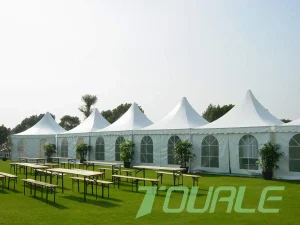
Challenge: Event rental companies require clear-span marquee tents that can be installed, dismantled, transported, and reconfigured rapidly across hundreds of venue sites annually.
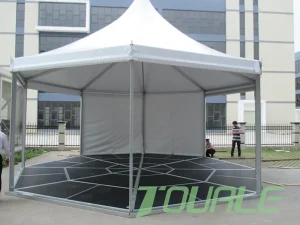
Solution: Standardized A-frame and pagoda aluminum modular truss systems utilizing Keder track insertion channels for fabric walls, minimizing wear and enabling 10x faster installation cycles.
Challenge: Rapid thermal expansion, intense UV degradation, severe sandstorms, and extreme day-to-night temperature fluctuations in desert ecosystems.
Solution: Triple-layer canopy setups with heat-reflective PVDF outer shade flies, insulated canvas inner shells, and heavy-duty sand-screw ground anchor arrays designed for soft substrates.
Challenge: High-salinity humidity causing metal corrosion, coupled with seasonal tropical typhoons and hurricane-force wind gusts.
Solution: 20-micron anodized aluminum structural profiles, marine-grade 316 stainless steel tension cables, structural gussets, and high-frequency welded waterproof fabric seams.
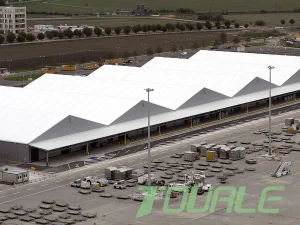
Challenge: Enterprise industrial facilities requiring urgent covered inventory storage without committing to permanent real estate construction zoning.
Solution: Heavy-duty multi-span A-frame and polygon structures with sandwich panel or rigid ABS sidewalls, creating insulated, clear-span industrial storage environments.
Challenge: Heavy snow loading, freezing winter temperatures, and structural drift risks in alpine mountain destinations.
Solution: Geodesic and high-spine roof geometries engineered for automatic snow shedding, coupled with synthetic thermal insulation quilts and multi-zone radiant heating duct integration.
How digital design, renewable energy integration, and sustainable material chemistry are shaping the future of commercial tent manufacturing.
As the outdoor hospitality and commercial event industries mature, tent manufacturing is undergoing a technology-driven evolution. The future safari camping tent is no longer a passive canvas enclosure, but an integrated, energy-efficient, smart structural unit. Key technological vectors over the next five-year horizon include:
The convergence of thin-film solar technology and structural architectural membrane fabrics is revolutionizing off-grid resort power architecture. Next-generation safari tent rainflies are being embedded with flexible CIGS solar cell layers. This enables each individual safari tent unit to generate up to 2.5 kW of clean electricity daily—sufficient to power climate control, low-voltage lighting, and guest amenities without relying on noisy diesel generators or intrusive grid trenching in wilderness areas.
By embedding micro-IoT environmental sensors within the canvas fabric layers, modern safari tents can automatically monitor humidity, internal CO2 levels, and ambient temperature differential. Automated roof-vent actuators and low-power heat exchangers automatically adjust ventilation flow, mitigating interior condensation—a classic challenge in traditional canvas lodging—while reducing active HVAC electricity demand by up to 40%.
Environmental governance (ESG) standards are compelling commercial tent manufacturers to eliminate traditional PVC plasticizers in favor of 100% recyclable Thermoplastic Polyurethane (TPU) coated textiles and organic bio-based canvas blends. End-of-life fabric reclamation programs ensure that decommissioned marquee roofs and safari tent covers are recycled into second-life industrial products rather than entering landfill streams.
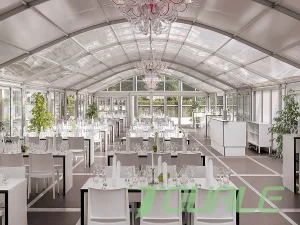
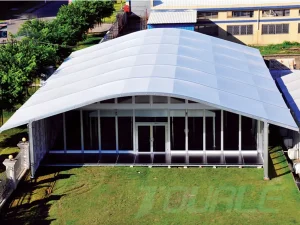
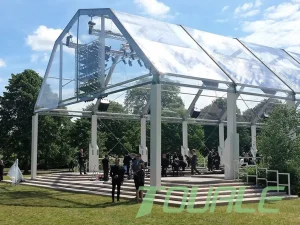
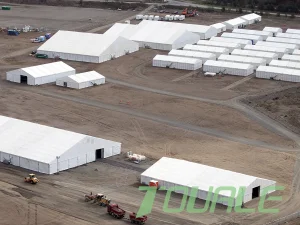
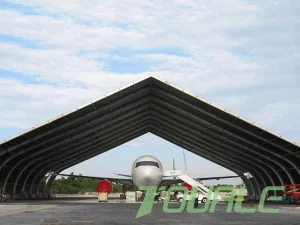
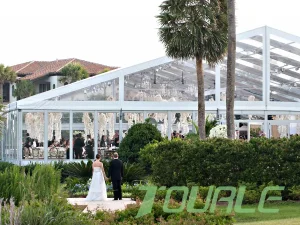
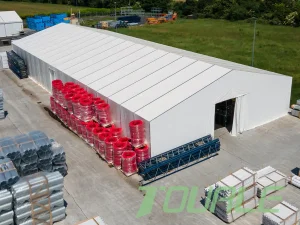
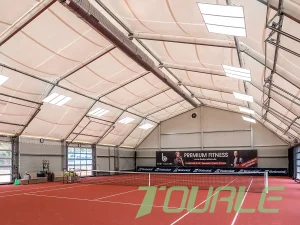
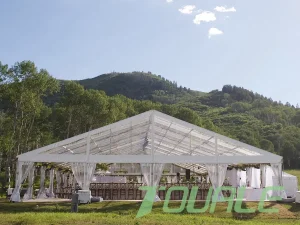
Complete architectural tent systems for heavy industrial warehousing, high-capacity banquet facilities, and large-scale sports arenas.
Answers to complex structural engineering, import logistics, wind-load ratings, and installation questions for B2B tent buyers.
Our heavy-duty commercial safari tents and aluminum clear-span marquee structures are calculated in accordance with structural engineering principles (EN 13782 standard for temporary structures). Frames built with 6061-T6 extruded aluminum profiles typically withstand wind loads from 80 km/h up to 120 km/h (0.5 kN/m² - 0.75 kN/m²), depending on bay spacing and ground anchoring. Custom alpine reinforcement kits are available to increase snow load capacity up to 0.5 kN/m².
By maintaining an integrated 18,000㎡ manufacturing facility with in-house hardware, aluminum machining, and computerized fabric cutting workshops, middleman distributor markups are eliminated. Cost efficiencies are derived from raw material scale purchasing (extruded aluminum billets and PVC/canvas rolls) and optimized automated production lines—delivering institutional-grade structures at factory-direct pricing while maintaining ISO-certified quality control.
We supply tailored foundation fixing packages: (1) Steel expanding anchors for concrete pads/slabs; (2) Heavy-duty steel earth stakes (0.8m to 1.5m length) for compacted soil and grassland; (3) Sand/snow screw anchors for soft beach or desert environments; and (4) Non-invasive heavy weight-plate ballast systems where ground drilling is strictly prohibited by site regulations.
Yes. All fabric membranes supplied across our safari and marquee tent series undergo rigorous third-party laboratory testing. Full certification copies (DIN 4102 B1, NFPA 701, CPAI-84, BS 7837) are provided with structural shipping documentation to assist resort developers and event planners with local municipal building and fire safety code approvals.
The main extruded 6061-T6 aluminum structural framework has an operational lifespan exceeding 15 to 20 years under proper maintenance. High-density PVDF outer flies typically last 8 to 12 years depending on solar UV radiation exposure, while inner canvas bodies last 6 to 10 years. All fabric components are modularly designed and can be re-ordered and replaced individually without modifying the underlying structural skeleton.
Prior to export packing, 100% of custom orders undergo full pre-shipment trial assembly at our factory testing grounds. Connections, Keder channel alignments, fabric tension fit, and structural hardware tolerances are thoroughly inspected and documented via video/photos. Detailed step-by-step engineering assembly manuals and remote technical video guidance are provided for resort installation teams.
Request an OEM/ODM architectural consultation, custom structural drawings, or an enterprise wholesale price quote directly from our engineering team.
Request Structural Catalog & Quotation