The global luxury glamping and semi-permanent structure market has evolved from a niche outdoor leisure segment into a mainstream institutional asset class. Driven by shifting consumer preferences toward eco-immersion, wellness tourism, and experiential travel, resort developers and commercial operators are increasingly pivoting toward high-value modular architectural envelopes.
Unlike traditional bricks-and-mortar hospitality projects requiring multi-year construction cycles and extensive capital commitments, OEM engineered glamping structures deliver unprecedented operational velocity. Institutional buyers benefit from accelerated project delivery schedules, minimal site impact, favorable municipal permitting pathways, and attractive CapEx-to-RevPAR ratios.
According to market intelligence data, the international glamping market is expanding at a CAGR exceeding 12.8%, with high-end luxury safari lodges, geodesic domes, and tensioned fabric marquee suites capturing the largest share of ADR (Average Daily Rate) growth in North America, Europe, and the Asia-Pacific region.
From alpine ski resorts in North America to desert eco-lodges in the Middle East and coastal retreats in Southeast Asia, heavy-duty OEM structures accommodate diverse micro-climates without compromising structural integrity or interior guest luxury.
Modern commercial glamping demands advanced structural calculation models. Advanced CAD/BIM finite element analysis ensures that every aluminum profile, structural membrane, and steel connection node meets stringent international building safety codes.
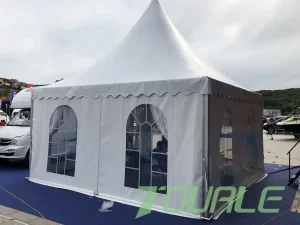
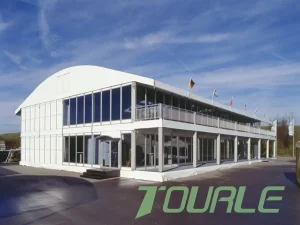
Beyond guest accommodation, commercial operators deploy custom high-peak structures for luxury outdoor dining pavilions, wedding atriums, pop-up brand activations, and clear-span temporary sports infrastructure.
China's industrial manufacturing clusters leverage vertical integration in 6061-T6 and 6082-T6 structural aluminum alloys. Automated multi-axis CNC processing ensures frame tolerances within ±0.5mm, delivering exceptional structural strength-to-weight ratios.
In-house fabric processing utilizes heavy-duty PVDF (Polyvinylidene Fluoride) coated double-sided PVC architectural textiles. Key advantages include UV radiation blockage, self-cleaning hydrophobic surface coatings, and flame retardancy compliant with DIN 4102 B1/M2.
Unlike trading intermediaries, direct manufacturing facilities operate dedicated hardware workshops. Every batch undergoes full-process trial assembly, load testing, and component fit verification prior to export container loading.
| Component Specification | Standard Commercial Grade | OEM Luxury/Industrial Grade | Performance Benefit |
|---|---|---|---|
| Main Structural Frame | Commercial Steel / standard 6063 Aluminum | Hard Pressed Extruded Aluminum 6061-T6 / 6082-T6 | Corrosion resistance, 20+ year frame life, lightweight transport |
| Membrane Fabric (Roof Cover) | 650g/m² Single-side PVC | 850g - 1050g/m² PVDF Coated Synthetic Fabric | Self-cleaning, anti-fungal, UV-blocker, thermal reduction |
| Fire Retardancy Rating | Basic GB Standard | DIN 4102 B1 / M2 / NFPA 701 Compliant | Meets global municipal safety codes for commercial occupancy |
| Connectors & Fasteners | Electro-galvanized Steel | Hot-Dipped Galvanized Steel (Thickness > 60μm) | Prevents rusting in coastal/high-humidity salt mist environments |
| Temperature Tolerance | -10°C to +40°C | -30°C to +70°C Cold/Heat Resistance | All-climate operational capability from snow resorts to deserts |
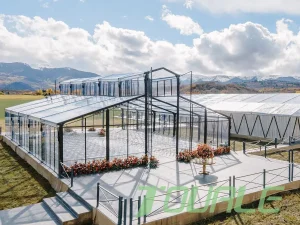
Glamping resorts, eco-lodges, and luxury glamping sites benefit from low-impact modular installation. Custom safari tents, geodesic domes, and tensioned fabric villas integrate effortlessly into natural landscapes without requiring deep concrete foundations, satisfying strict environmental regulations while commanding premium nightly pricing.
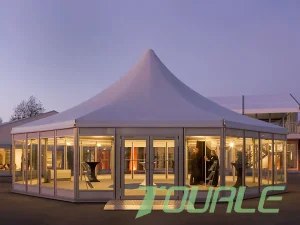
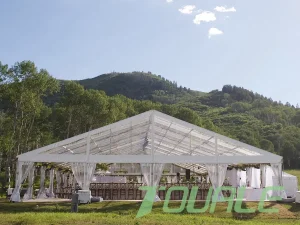
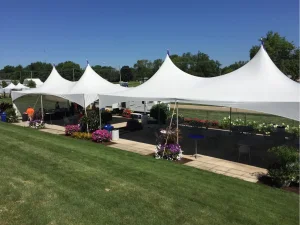
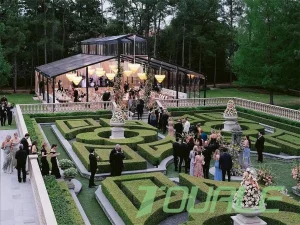
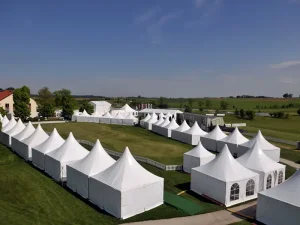
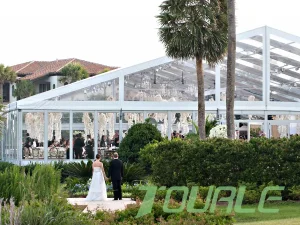
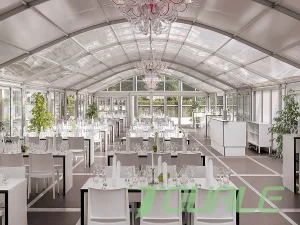
Wedding planners, event rental companies, and luxury hotel chains utilize clear-span high-spine A-frame tents and fully transparent atrium structures. With no central interior pillars, operators achieve 100% floor plan utilization for banquets, trade exhibitions, and VIP galas.
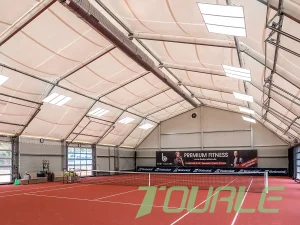
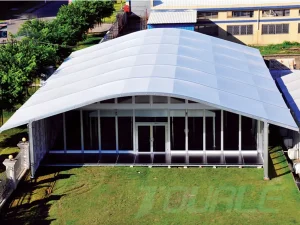
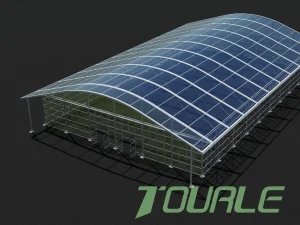
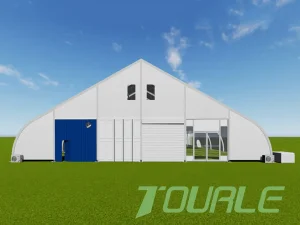
High-arch curve tents (TFS series) and polygon structural enclosures transform outdoor land into year-round tennis courts, football facilities, basketball arenas, and swimming pool enclosures. High roof peaks accommodate rapid air exchange and specialized sports lighting installation.
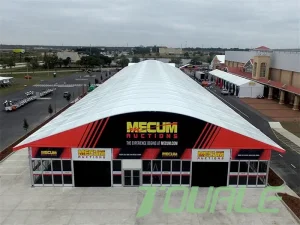
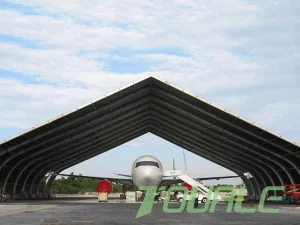
Global logistics providers and corporate enterprises deploy heavy-duty aluminum marquee tents as semi-permanent storage facilities, emergency logistics hubs, and aviation hangars. Fast erection speeds deliver instant operational capacity during peak demand cycles.
Define localized wind load requirements (m/s or km/h), ground topography, soil anchor holding capacity, and extreme weather metrics (snow accumulation, temperature variance).
Collaborate with the factory design team to finalize span dimensions, peak heights, sidewall options (glass walls, ABS hard panels, transparent PVC), and internal flooring integration.
Request trial installation video inspection reports, tensile testing records, membrane flame retardancy certifications, and frame load-bearing audit documentation.
When evaluating OEM exporters, purchasing managers must look beyond initial FOB price points. High-performance aluminum structures provide significantly lower life-cycle operational costs compared to low-cost steel or non-treated timber alternatives.
Modern glamping units incorporate insulated double-skin membrane roofs with vacuum-insulated panels (VIP). Integrated HVAC ducting, automated solar shading, and IoT thermal sensors maintain climate stability in extreme external temperatures.
The boundary between soft tents and permanent buildings is dissolving. High-end OEM glamping designs combine structural aluminum frameworks with double-glazed low-E glass walls, insulated rockwool sandwich panels, and luxury sliding doors.
Leading resort developers prioritize fully off-grid structural pods. Innovations include flexible thin-film photovoltaic roof coatings, integrated rainwater collection gutters, and micro-greywater filtration system compatibility.