As Costa Rica accelerates its economic expansion across Free Trade Zones (FTZs), eco-resort tourism, and agricultural export logistics, rapid-deployment clear-span A-frame tents offer unmatched operational flexibility and structural performance.
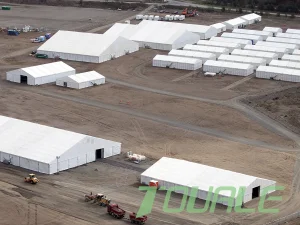
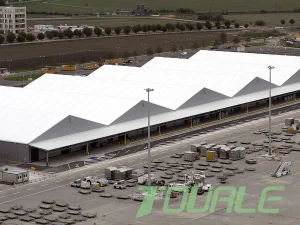
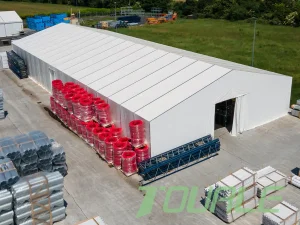
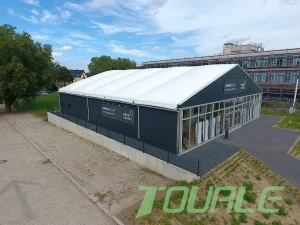
Costa Rica presents a unique economic landscape in Central America. Renowned for its commitment to environmental sustainability, carbon neutrality goals, and robust foreign direct investment (FDI), the demand for non-permanent, eco-friendly, and highly durable building solutions has experienced exponential growth.
Industrial corridors such as Coyol Free Zone (Alajuela), Zona Franca América (Heredia), and Cartago high-tech clusters require rapid, scalable warehouse space. Modular A-Frame structures eliminate 8 to 12 months of traditional masonry permitting and construction delays.
In high-end eco-resort regions like the Papagayo Peninsula, Guanacaste beach corridor, Santa Teresa, and Manuel Antonio, hospitality operators utilize clear-span A-frame tents for wedding marquees, dining pavilions, and luxury event spaces without altering delicate topsoils or clearing natural flora.
In agricultural hubs surrounding Limón and Puntarenas, massive temporary covered storage is vital during pineapple, banana, and coffee harvest peaks. Clear-span A-Frame tents provide immediate shade and moisture-controlled staging zones near primary transport arteries.
Strategic Procurement Insight: Under Costa Rica’s Regimen de Zona Franca (Law No. 7210), capital investments in demountable structural assets like modular aluminum A-frame tents often qualify for accelerated asset depreciation and duty-free import tax exemptions when deployed in export processing operations.
From intense UV exposure in dry-tropical Guanacaste to persistent high humidity and salt spray along the Pacific coast, standard commercial tents fail prematurely. Our engineering process incorporates specialized metallurgy and chemical resistance profiles specifically for Tropical Regions (Köppen climate classification Af, Am, Aw).
Standard steel frame structures corrode rapidly under Costa Rica’s coastal humidity and marine air (Corrosivity Category C4/C5). We utilize extruded 6061-T6 structural aluminum alloy with a minimum 15-micron anodized coating. Connectors and hardware are engineered with hot-dip galvanized steel or 316 stainless steel, eliminating galvanic oxidation risk.
Our roof covers feature heavy-duty 850g/m² double-coated PVC polyester fabric treated with PVDF (Polyvinylidene Fluoride) lacquering. This self-cleaning outer layer repels tropical rain soot, prevents algae and mold growth caused by extreme ambient humidity, and reflects up to 88% of solar radiation (UV index 11+ mitigation).
Costa Rica experiences seasonal "Vientos del Norte" (Papagayo winds) that reach speeds exceeding 100 km/h, as well as high seismic activity. The flexible nature of aluminum clear-span trusses combined with high-tensile steel cable bracing allows the A-Frame structure to dissipate seismic force vectors better than rigid concrete masonry.
All fabrics strictly adhere to international fire safety standards: DIN 4102 B1/M2 and NFPA 701. For climate-controlled operational spaces (e.g., temporary offices, luxury ballrooms, storage of heat-sensitive goods), double-layer thermo-insulated roof systems are available to cut HVAC power consumption by up to 40%.
| Engineering Metric | Standard Steel Frame Tents | Tourle 6061-T6 Aluminum A-Frame Tents | Local Masonry / Steel Buildings |
|---|---|---|---|
| Corrosion Resistance (Salt/Humidity) | Low (Rusts in 12–18 months) | Exceptional (25+ Years No Corrosion) | Moderate (Requires constant repaint) |
| Wind Resistance Standard | 60–80 km/h | 100–120 km/h (ASCE 7-16) | 120+ km/h |
| Deployment Speed (1,000 m²) | 2–3 Weeks | 3–5 Days | 6–9 Months |
| Seismic Adaptability | Rigid / Fracture Risk | High Dynamic Absorption | Requires Complex Engineering |
| Relocation & Resale Flexibility | Difficult / High Material Loss | 100% Reusable & Modular | Zero (Permanent Asset) |
When evaluating procurement options for commercial A-frame tents in Costa Rica, enterprise buyers must analyze the Total Cost of Ownership (TCO), including FOB/CIF logistics costs, import tariffs, foundation preparation, sidewall upgrades, and installation overhead.
Pricing for A-Frame clear-span structures is predominantly calculated on a per-square-meter ($/m²) basis. As structural span width increases (e.g., from 10m to 40m wide), the internal profile aluminum extrusions must increase in cross-sectional thickness (e.g., 122x68x3mm vs. 300x125x5/8mm profiles) to handle heavy wind loads without central support columns.
*Note: Prices vary depending on local wind load specifications, custom sizing, and shipping rates to Puerto Moín (Atlantic) or Puerto Caldera (Pacific).
Direct ocean freight lines connect our factory to Costa Rica’s major entry ports: Puerto Caldera on the Pacific side and Puerto Moín (APM Terminals) on the Caribbean side. Containerized shipments (20GP / 40HQ) ensure safe delivery with moisture-barrier export packing.
A-Frame tents can be installed on virtually any site without expensive concrete foundations. Options include expansion bolts for concrete slabs, steel ground stakes for grass/soil, and heavy weight ballast plates for eco-protected surfaces.
Built on modular bay increments (3m or 5m bay distances), you can extend or shorten the length of your structure at any time. A 20x30m tent can easily be converted into a 20x50m structure by acquiring additional mid-bay sections.
Navigating structural permitting in Costa Rica requires adherence to national safety and building codes overseen by the Colegio Federado de Ingenieros y de Arquitectos (CFIA) and municipal authorities (Municipalidades).
We provide enterprise clients with comprehensive engineering packages designed to facilitate smooth permit approvals:
Our engineering department can supply complete structural schematics and wind calculation packets for your upcoming Costa Rica development project.
Contact Engineering TeamAligning with Costa Rica’s Plan Nacional de Descarbonización 2018-2050, our next-generation A-Frame structures incorporate smart technologies and sustainable material lifecycles.
Thin-film flexible Building-Integrated Photovoltaics (BIPV) attached directly to the PVC roof membrane. Generates off-grid solar energy for eco-lodges in remote coastal and rainforest zones without adding significant dead weight to the aluminum frame.
Embedded strain gauges and wireless micro-sensors monitor wind vibration, frame load tension, internal thermal humidity levels, and membrane stress in real time—alerting facility managers via mobile apps prior to extreme storm events.
100% of the 6061-T6 aluminum alloy structure is infinitely recyclable without property degradation. Our PVC fabric membranes are manufactured under closed-loop chemical recycling programs, minimizing landfill waste.
Browse our specialized range of modular A-frame, marquee, clear-roof, and custom polygon tent solutions available for direct export to Costa Rica.
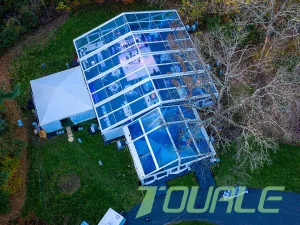
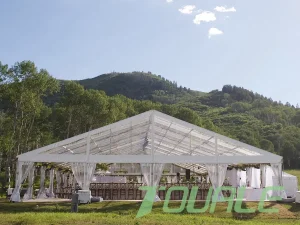
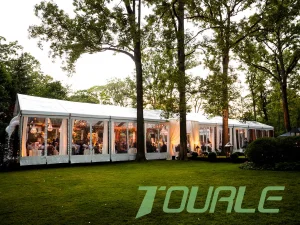
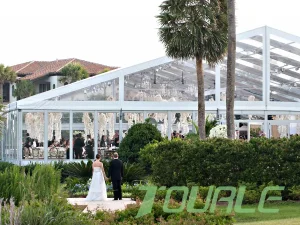
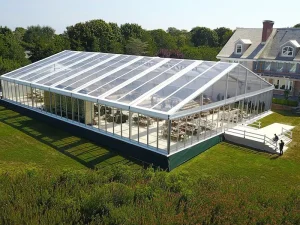
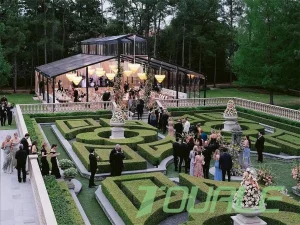
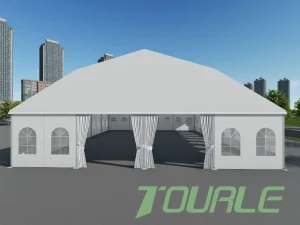
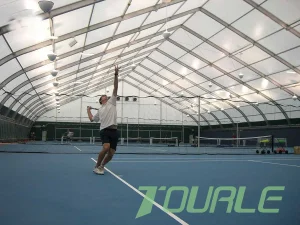
In-depth answers regarding structural engineering, logistics, customs clearance, and operational maintenance for A-frame tents in Costa Rica.
Our A-Frame tents are engineered with steep roof pitches (typically 18° to 22°) and high-tension PVDF-coated PVC membranes that promote instant water runoff, preventing ponding even during heavy tropical downpours (such as those experienced in Puntarenas or Limón). All frame seams utilize high-frequency welded weather flaps and EPDM rubber seals, guaranteeing 100% waterproof interior protection.
Minimal foundation work is required compared to permanent steel buildings. On asphalt or existing concrete pads in Free Trade Zones, the tent baseplates are fixed directly using heavy-duty chemical expansion anchors. On soil, grass, or gravel at agricultural/resort sites, steel stakes (800mm to 1200mm length) are driven into the earth. For eco-sensitive protected land, non-intrusive concrete weight ballast blocks are utilized.
Average ocean transit times from our manufacturing port to Costa Rica’s major ports (Puerto Caldera on the Pacific or Puerto Moín on the Caribbean) range from 24 to 32 days. Manufacturing and factory trial-assembly typically require 15 to 20 days depending on custom wall configurations, resulting in a total project lead time of approximately 6 to 7 weeks from order sign-off.
Yes. We specialize in climate-controlled A-frame structures equipped with integrated HVAC ducting ports, insulated double-layer roofs, and sandwich panel sidewalls (50mm–100mm Rockwool or EPS insulation). This setup maintains indoor ambient temperatures at 21°C–23°C even during peak Guanacaste summer heat (35°C+ external temperature).
The structural 6061-T6 aluminum alloy framework has an engineered operational lifespan exceeding 25 years with virtually zero structural maintenance. Premium PVDF-lacquered PVC membrane covers typically last 8 to 12 years under intense tropical UV exposure, after which individual roof panels can be easily replaced or re-tensioned without dismantling the aluminum framework.
Our technical sales engineers provide direct factory pricing, preliminary CAD site layouts, wind load calculations, and shipping estimates to San José, Guanacaste, Limón, or Puntarenas within 24 hours.