Premium structural tensioned fabric systems (TFS) compliant with CE standards, tailored for industrial storage, aviation hangars, and sports facilities in Nagoya.
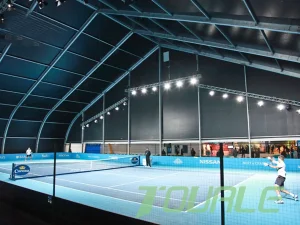
Nagoya Standard 40m Wide TFS Event & Tennis Sport Tent System
View Specifications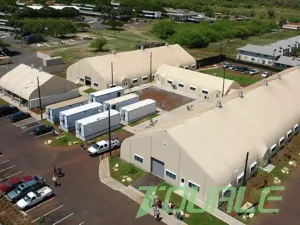
Nagoya Port Industrial Curved TFS Aluminum PVC Storage Tent
View Specifications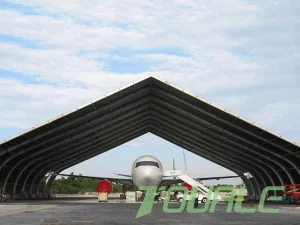
High Arch Roof Aircraft Hangar & Maintenance Tent Structure
View Specifications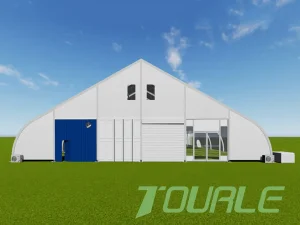
Multi-Sport TFS Curve Tent for Tennis, Basketball & Football Hubs
View SpecificationsAs the economic core of the Chubu region and Japan’s capital of automotive manufacturing, Nagoya (Aichi Prefecture) represents a unique intersection of high-density industrial production, maritime logistics, and rapidly evolving commercial infrastructure. Home to global industrial giants including the Toyota Group, Mitsubishi Heavy Industries, and major aerospace clusters, the Greater Nagoya area experiences persistent structural demands for rapid-deployment, high-clearance, and weather-resilient space solutions.
Traditional permanent construction in Japan faces rigorous planning cycles, soaring material costs, and lengthy municipal permitting processes. Consequently, enterprise procurement managers, industrial project developers, and event operators in Nagoya are increasingly turning to CE-certified modular clear-span aluminum structures and Tensioned Fabric Structures (TFS). These temporary and semi-permanent structural enclosures deliver unmatched spatial efficiency, rapid installation timelines, and compliance with high seismic and coastal wind loads characteristic of Mikawa Bay and Ise Bay geographic zones.
Rapid expansion solutions for tier-1 automotive component storage, vehicle staging yards, and temporary manufacturing sub-assembly halls across Toyota City and the Greater Nagoya area.
Rigorous structural integrity validation verified by European standards, ensuring precise safety factors against dynamic wind pressures, structural deformation, and fire safety (DIN 4102 B1/M2).
Engineered using high-tensile extruded aluminum alloy (6061-T6), designed to absorb lateral forces during seismic activity and withstand coastal wind pressure up to 120 km/h (33 m/s).
Understanding the mechanical specifications, material science, and safety metrics required for deploying heavy-duty tensioned fabric structures in Nagoya.
In international B2B structure procurement, certification is not merely a formality; it is the fundamental proof of engineering safety and operational durability. Tourle Tent (Sichuan Tulele Technology Co., Ltd.) manufactures modular aluminum tents adhering strictly to the European standard EN 13782 (Temporary Structures - Tents - Safety) and EN 1090 (Execution of Steel and Aluminium Structures).
The core framework of our TFS high-arch curved tents and large event marquees is constructed from 6061-T6 high-strength anodized aluminum alloy. With a tensile strength exceeding 290 MPa and yield strength over 240 MPa, this profile delivers an optimal strength-to-weight ratio. The anodized oxidation film (minimum 10-15μm) provides exceptional corrosion resistance against the humid maritime atmosphere surrounding Nagoya Port and coastal Aichi industrial zones.
The roof covers and sidewalls utilize double PVC-coated polyester textiles ranging from 650g/m² to 850g/m². Key performance metrics include:
| Engineering Specification | TFS High-Arch Curved Tent | Standard A-Frame Marquee | Conventional Steel Warehouse |
|---|---|---|---|
| Primary Structural Frame | Anodized Aluminum 6061-T6 (High-Arch Beam) | Anodized Aluminum 6061-T6 (Gable Profile) | Structural Q235/Q345 Heavy Steel |
| Clear-Span Apex Height | Extremely High (Up to 12m-15m on 40m span) | Standard Slope (Up to 6m-8m) | Variable (Fixed Column Heights) |
| Max Wind Resistance Rating | 100 km/h - 120 km/h (EN 13782) | 80 km/h - 100 km/h | Custom Municipal Code |
| Deployment Speed | Rapid (1,000 m² installed in 48 hrs) | Rapid (1,200 m² installed in 36 hrs) | Slow (6 to 12 Months Minimum) |
| Foundation Requirements | Minimal (Expansion Bolts / Weight Plates) | Minimal (Ground Anchors / Bolts) | Heavy Reinforced Concrete Footings |
| Relocation Flexibility | 100% Demountable & Modular | 100% Demountable & Modular | Permanent (Non-relocatable) |
Integrating end-to-end design, CNC precision machining, hardware casting, and full-process trial assembly under one 18,000㎡ production center.
By eliminating third-party intermediaries, Tourle Tent provides Nagoya procurement directors, rental fleets, and engineering firms with direct factory pricing, full OEM/ODM customization, and strict quality control protocols.
In 2019, we expanded our operational capabilities by establishing an independent dedicated hardware factory. Every connector, steel base plate, roof tensioning rod, and side truss bracket is manufactured internally using CNC automated laser cutting and robot-assisted welding. This guarantees complete zero-tolerance mechanical fitting, eliminating assembly bottlenecks on-site in Japan.
As Japan's highest-tonnage maritime port, Nagoya Port requires massive buffer storage for international cargo, customs bonded clearing, and heavy machinery protection. Our TFS Curve Tents, with side wall heights ranging from 4m to 8m, provide clear-span clearance for multi-tier pallet racking and container forklift maneuvering. Equipped with automated roll-up shutter doors and anti-condensation roof covers.
Suburban municipalities across Aichi (Toyota, Okazaki, Ichinomiya) are actively modernizing public and commercial sports infrastructure. Converting open courts into covered, year-round centers for tennis, basketball, badminton, and futsal is seamless with a 40m-wide TFS curved roof system. Transparent PVC skylight panels reduce daytime electric lighting costs by up to 70%.
To support massive B2B trade conventions, automotive exhibitions, and regional outdoor festivals, event rental companies require modular marquee systems that can be swiftly combined, expanded, or reconfigured bay by bay (5m distance per bay). Our peach-shape and multi-sided polygon tents offer stunning aesthetic profiles for VIP brand activations.
Near Chubu Centrair International Airport (NGO) and Nagoya Airfield (Komaki), aerospace contractors require high-arch maintenance hangars. Our customized TFS arch tents feature oversized electric bi-folding hangar doors capable of accommodating private jets, helicopters, and UAV maintenance bays without central structural interference.
Explore our full line of modular marquee tents, luxury event structures, transparent arch roofs, and multi-side pavilions optimized for international sea freight and fast assembly.
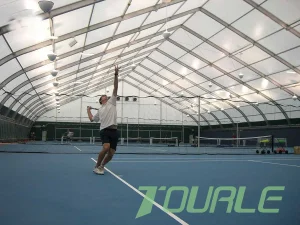
Nagoya Large Peach Shape Marquee Sport & Event Structure
View Specifications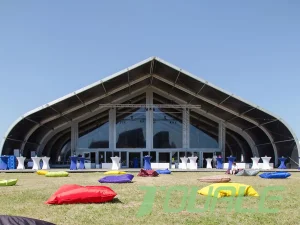
OEM Aluminum TFS Peach Marquee for Weddings, Dining & Expos
View Specifications
Custom Outdoor Tennis Court & Badminton Field Enclosure
View Specifications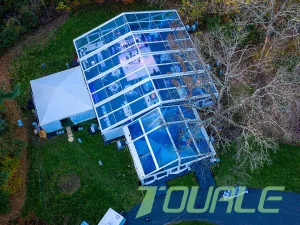
Luxury Transparent PVC Roof Aluminum Event Marquee Tent
View Specifications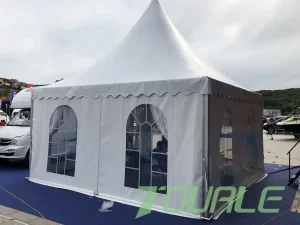
5x5m Commercial High Peak Canopy Pagoda Tent for Entry Modules
View Specifications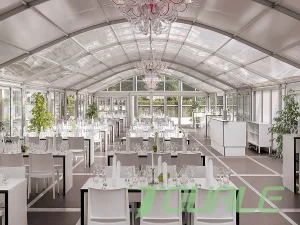
Fireproof & Waterproof Clear Arch Tent for High-End Events
View Specifications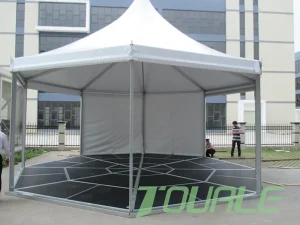
Custom Multi-Side Round Design Function Tent Structure
View Specifications
Custom Curved TFS Marquee Tent for Multi-Purpose Arenas
View SpecificationsProcuring large-scale structural tents internationally requires a highly coordinated logistics framework. Tourle Tent’s specialized export department handles every detail, ensuring seamless shipping, customs clearance documentation, and site-ready component organization for buyers across Japan.
Our structural engineering team produces customized 2D site layouts and 3D CAD models tailored to Nagoya wind zone calculations and site dimensions prior to fabrication.
100% of manufactured frames undergo full or trial bay assembly in our 18,000㎡ factory. Membrane tensioning, bolt alignments, and component numbering are verified with video documentation provided to the buyer.
Packed in specialized iron frames and protective membrane wrapping, goods are loaded into 40ft HQ container ships directly routed from China to the Port of Nagoya with standard 7-10 day sea transit time.
Detailed answers regarding CE compliance, Japanese structural regulations, wind anchoring methods, and factory customization.
The European standard EN 13782 is one of the world's most stringent regulatory frameworks for temporary and semi-permanent structures. It rigorously calculates load resistance against dynamic wind velocity, snow loads, and structural stability. For Japanese clients, our EN 13782 engineering structural calculation books provide a complete, verifiable mathematical baseline that assists local architect reviews and temporary building usage applications under Japanese Building Standard Law regulations.
On existing industrial concrete slabs or asphalt paving commonly found in Nagoya depots, we utilize heavy-duty chemical expansion anchors or mechanical wedge bolts drilled into the concrete base plates. For sites where ground excavation is strictly prohibited, we provide engineered heavy weight plate ballast systems (using concrete blocks or water tanks) to ensure required uplift wind resistance without damaging the ground surface.
TFS High-Arch Tents feature a streamlined, high-peak curved roof profile that significantly reduces wind pressure coefficients compared to traditional flat vertical sidewalls. The high-tension PVC membrane roof is pulled taught in structural aluminum channels using specialized tensioning bars, preventing water pooling during torrential typhoon rainfalls and rapidly shedding precipitation.
Yes. While standard clear-span widths range from 10m to 50m with eave heights up to 6m, our in-house engineering team designs fully customized aluminum beam profiles, bay spacings (3m or 5m increments), and custom sidewall configurations (glass wall panels, insulated sandwich panels, ABS hard walls, or PVC curtains) to maximize your exact plot dimensions.
Production lead time generally takes 15 to 25 days depending on structure complexity and surface area. Ocean freight shipping from Chinese major ports (such as Shanghai or Ningbo) to the Port of Nagoya takes approximately 4 to 7 days direct transit, allowing total project delivery well within 30 to 40 days from contract approval.