Engineered for high wind resistance, rapid installation, and weatherproofing under North Vietnam’s subtropical climate conditions.
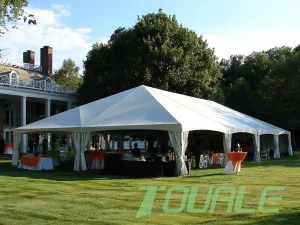
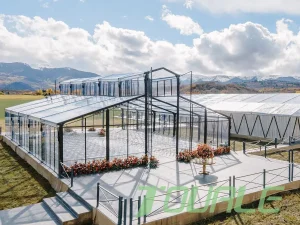

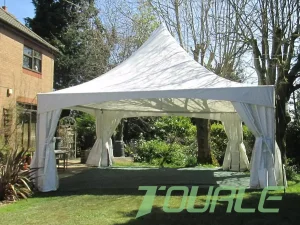
The Greater Hanoi region—encompassing core urban districts such as Nam Tu Liem, Tay Ho, and Long Bien alongside adjoining industrial corridors in Bac Ninh, Hung Yen, and Haiphong—is experiencing an unparalleled expansion in macro-commercial infrastructure. As Northern Vietnam consolidates its role as a global high-tech manufacturing base and a premier South-East Asian destination for MICE (Meetings, Incentives, Conferences, and Exhibitions), traditional permanent brick-and-mortar venue development can no longer match the speed of economic growth.
This dynamic has propelled TFS (Tensioned Fabric Structures) and modular aluminum clear-span tents from temporary event solutions into mission-critical corporate and industrial infrastructure. Global enterprises, event producers, logistics operators, and municipal authorities in Hanoi now demand high-rigidity structural frameworks capable of withstanding severe subtropical climate events (including Category 3–5 typhoons originating in the Gulf of Tonkin) while maintaining compliance with local building ordinances and international safety standards.
Unlike conventional A-frame marquee tents, a true TFS tent operates on an advanced high-tension curved arch geometry. The principal rafters utilize extruded heavy-duty structural aluminum profiles (6061-T6 alloy), pre-curved into fluid parabolic or polygonal profiles. The PVC/PVDF composite roof membrane is inserted directly into continuous dual-keder channels integrated into the aluminum rafters, and subsequent longitudinal tensioning is executed via automated hydraulic or high-torque mechanical tensioning assemblies.
The smooth curved arch reduces wind pressure coefficients compared to traditional flat-sloped gables. Airflow glides over the roof membrane, drastically minimizing uplift forces during North Vietnam monsoon storm surges.
Eliminates fabric flapping, water ponding, and micro-tears under torrential rain conditions typical of Hanoi’s wet season (May to October), extending total membrane operational life beyond 10–15 years.
With interior eave heights up to 10–12 meters, TFS structures accommodate multi-story indoor exhibition booths, heavy industrial crane rigs, and automated warehousing stackers without structural obstruction.
Furthermore, structural reliability in Hanoi's environment relies heavily on anti-corrosion chemistry. The humid subtropical environment in the Red River Delta quickly oxidizes untreated metal. Qualified exporters provide anodized aluminum profiles with oxide film thickness exceeding 15 microns (μm), combined with hot-dip galvanized steel connection components (zinc coating weight ≥ 500 g/m²), protecting against atmospheric oxidation and industrial pollutant degradation.
Below is a comparative engineering baseline detailing performance metrics across structural tent classes exported for Hanoi enterprise applications:
| Engineering Specification | TFS Curved Arch Structure | Standard A-Frame Marquee | Polygon Multi-Side Venue |
|---|---|---|---|
| Main Profile Alloy | 6061-T6 High-Strength Aluminum | 6061-T6 Hard Extruded Aluminum | 6061-T6 Structural Profile |
| Wind Resistance Rating | Up to 120 km/h (34 m/s) | 80 - 100 km/h (22 - 28 m/s) | 100 km/h (28 m/s) |
| Roof Tensioning Method | Continuous Keder & Mechanical Tensioners | Standard Bar Tensioning System | Hydraulic & Screw Tensioning |
| Clear-Span Width Range | 15m to 60m (Unobstructed) | 3m to 50m | 18m to 60m |
| Flame Retardancy Standard | DIN 4102 B1, M2 / NFPA 701 | DIN 4102 B1, M2 | DIN 4102 B1, M2 |
| Thermal Range Operating Limit | -30°C to +70°C | -30°C to +70°C | -30°C to +70°C |
| Eave Height Capability | 6.0m to 12.0m | 3.0m to 6.0m | 4.0m to 8.0m |
TFS tent services and exporters cater to three macro-economic pillars within Hanoi and surrounding provinces:
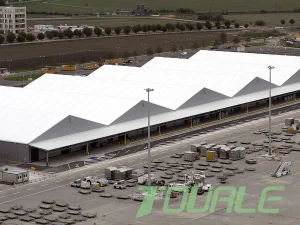
Industrial parks in Bac Ninh, Thai Nguyen, and Dong Anh house major global electronics manufacturers and automotive suppliers. Seasonal production spikes and supply chain shifts require rapid space expansion. TFS temporary warehouse tents can be deployed directly on asphalt or concrete ground without deep foundation excavation, serving as bonded warehouses, raw material holding bays, or cleanroom buffer zones within days.
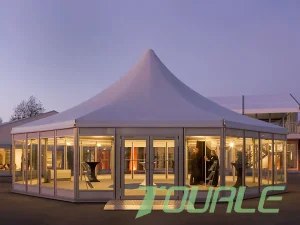
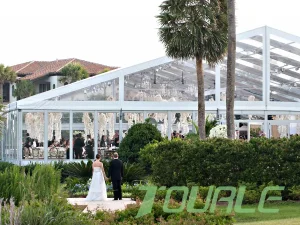
Hanoi’s city center frequently hosts international summits, industrial machine expos, and luxury automotive launches. Venues like the National Exhibition Construction Center (NECC) and My Dinh Sports Complex leverage large clear-span TFS structures to expand indoor exhibition footprints. Transparent PVC covers, glass wall modules, and integrated cassette flooring convert raw ground into high-end, climate-controlled temporary convention halls.
Infrastructure development across Hanoi often calls for temporary site covers, field maintenance workshops, and emergency relief command shelters. TFS tents provide relocatable operational bases that can be dismantled, stored, and redeployed to new construction zones across North Vietnam without material fatigue.
Deploying large temporary structures within Hanoi municipality requires strict adherence to Vietnamese safety regulations and international manufacturing standards. Global enterprise buyers and local contractors must ensure full alignment across the following regulatory pillars:
As the international tent export industry advances, next-generation TFS units entering the Hanoi market integrate smart structural technology and green building principles:
IoT-enabled strain gauges and anemometers embedded into main rafter joints to provide real-time structural load monitoring during typhoon alerts.
Flexible PVDF membranes laminated with thin-film solar cells to generate auxiliary green energy for interior illumination and HVAC systems.
Double-layer thermal roof insulation systems engineered to reduce HVAC energy consumption in Hanoi’s hot summer months by up to 35%.
Transitioning toward zero-halogen, 100% circular PVC/PVDF materials compliant with EU REACH and environmental ESG mandates for global buyers.
Explore our full engineering portfolio available for direct factory shipment and turnkey installation support in Hanoi.
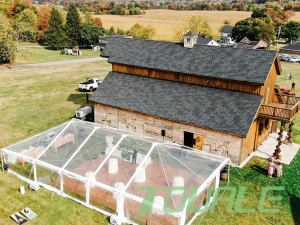
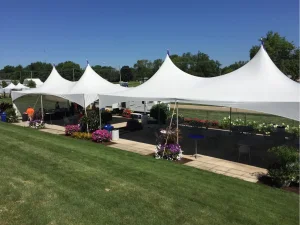
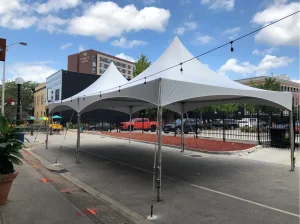
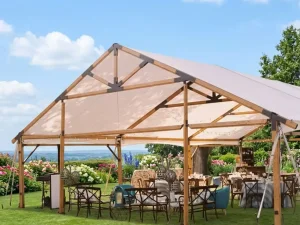
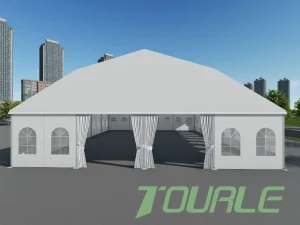
In-depth structural, logistical, and commercial answers for enterprise buyers and engineering consultants.
TFS (Tensioned Fabric Structures) utilize a parabolic arc profile combined with high mechanical membrane pre-tensioning. This engineering configuration provides superior aerodynamic efficiency against typhoon winds (rated up to 120 km/h), eliminates water pooling during heavy Red River Delta monsoon rains, and affords high interior apex clearance (up to 12 meters) without center support poles. This makes TFS ideal for high-capacity expos, industrial logistics, and mega-scale events in Hanoi.
Structures are flat-packed into standard 20ft or 40ft High Cube (HQ) shipping containers at the factory. Ocean freight shipments route directly into Haiphong Port or Lach Huyen Deepsea Terminal. From Haiphong, cargo travels via the Hanoi-Haiphong Expressway (CT04) directly to site locations in Hanoi city center or nearby industrial zones (Bac Ninh, Hung Yen) within 2 to 3 hours of customs clearance.
For industrial concrete floors (such as warehouse bays or expo grounds), heavy-duty steel expansion anchors or chemical bolts are used. On soft ground or paved surfaces where ground penetration is restricted, heavy concrete ballast block systems (encased in customized aesthetic covers) provide non-destructive anchoring to withstand certified wind loads.
Yes. Premium export-grade covers utilize high-tenacity polyester woven base fabrics coated on both sides with PVDF (Polyvinylidene Fluoride) lacquering. This surface layer blocks UV radiation, resists fungal/mold growth in 90%+ relative humidity, reduces dirt adhesion, and maintains structural integrity across thermal ranges from -30°C to +70°C.
Absolutely. While standard configurations use heavy PVC sidewalls, export TFS units frequently incorporate modular tempered glass wall panels, ABS hard walls, or insulated sandwich panel walls. Integrated double-wing glass doors and custom HVAC ducting ports accommodate industrial mobile air conditioning systems required for Hanoi's humid summer months.
Standard manufacturing lead time at our production base ranges from 15 to 25 days depending on total square footage and custom profile requirements. Shipping to Haiphong Port takes approximately 5 to 7 days. On-site installation by a skilled team proceeds rapidly: a standard 2,000 m² TFS clear-span structure can be fully assembled on site within 3 to 5 days under technical supervision.
Get comprehensive technical drawings, structural calculation reports, wind load certifications, and direct factory quotation for your Hanoi event or industrial site.
Send Inquiry Now